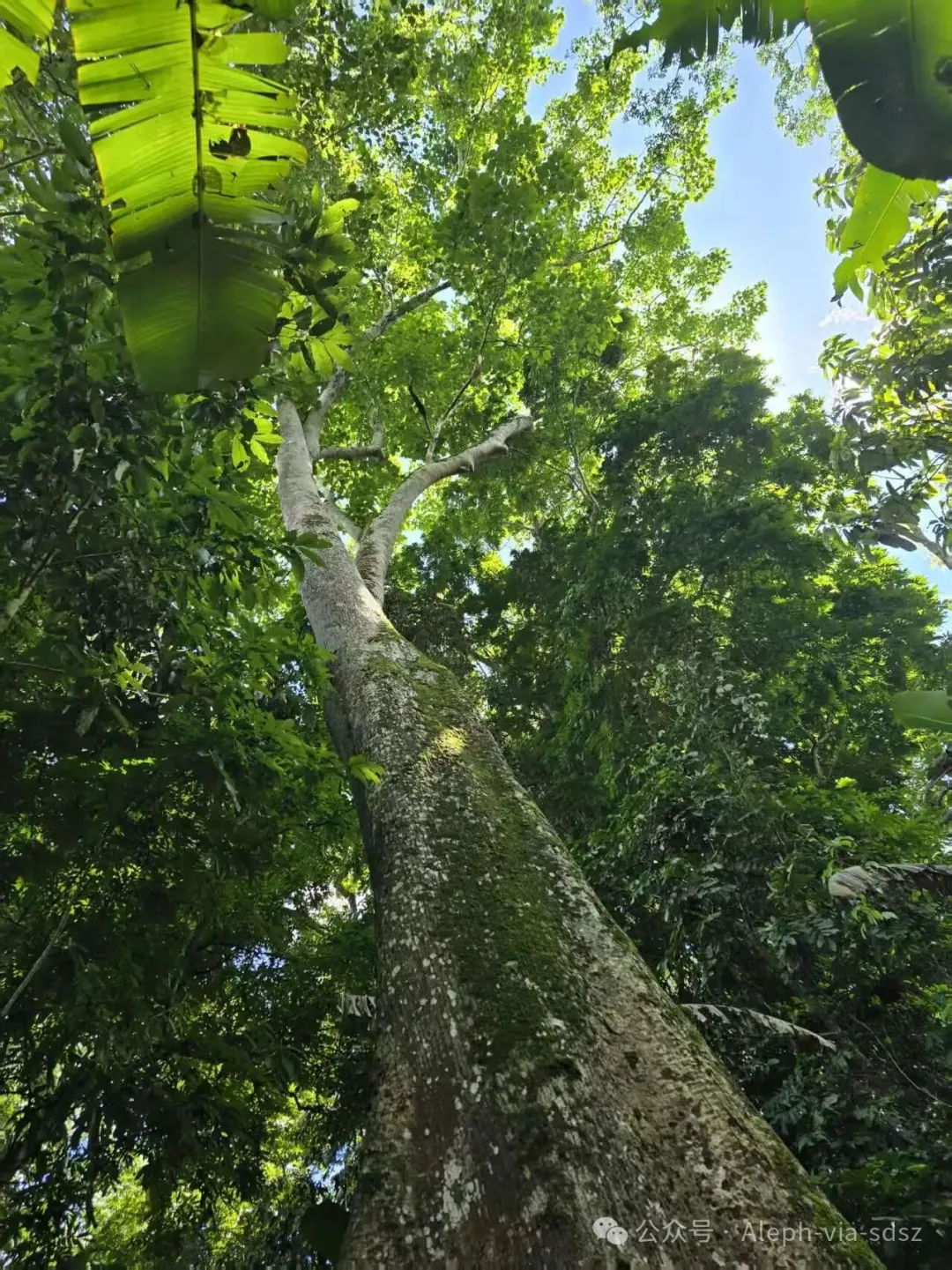
Driving along the winding mountain roads of Xishuangbanna, it’s easy to be “deceived” by the overwhelming expanse of lush greenery.
The mountains and fields are covered with lush forests, but as soon as you slow down and look closely through the car window, that verdant veil quickly peels away to reveal an alarming reality:
The entire mountainside has been meticulously carved into terraces resembling contour lines, and row upon row of artificial rubber trees—with their straight trunks and orderly arrangement—resemble characterless industrial parts, their bark covered with dense, diagonal gray scars and small plastic cups hanging from them to collect sap.
Beneath this canopy, there are no tangled ancient vines, no fluttering epiphytic orchids, nor the lush shrubs and roaring wildlife of a multi-layered rainforest—only exposed, crusted red soil and gullies carved out by rainwater. This is what environmentalists refer to as the infamous “green water pump” and “green desert.”
Yet when you drive along the highway into Jinghong or a well-known scenic area, the visual experience instantly shifts to the other extreme:
Massive gilded pagodas rise from the ground, their eaves and bracket sets reflecting a dazzling golden glow under the scorching southern sun; in the scenic area’s plaza, hundreds or even thousands of tourists clad in synthetic Dai-style tube skirts, water guns in hand, scream and jostle amid the scheduled “Water Splashing Carnival.”
Nature still appears to be boundless green, while religion seems more flourishing and boisterous than ever before.
However, beneath this façade of prosperity—woven together by green vegetation and golden temples—Xishuangbanna’s native tropical rainforest and the ecological ethics it embodies have undergone the most thorough and profound systemic collapse in the southwestern frontier.
It has undergone two rounds of brutal “formatting”:
- The First Phase: A radical modernist transformation driven by state will;
- The Second Phase: A landscape-oriented consumerist reshaping propelled by capital and the cultural tourism industry.
I. The First Round of “Formatting”: High Modernism and the “Mass Clearance” of the Rainforest
In anthropologist James C. Scott’s classic work Seeing Like a State, he provided a profound analysis of a governing impulse known as “High Modernism”: in the name of reason, science, and progress, the state attempts to forcibly transform the inherently complex, chaotic, and unquantifiable natural world and traditional societies into a singular order that is simple, rule-based, and easily accounted for and controlled by the central administrative system.
Xishuangbanna from the 1950s to the 1970s serves as the most compelling historical example of this theory.
Deep in history, the indigenous Dai people maintained a highly sophisticated religio-ecological order. This order was built upon a dual network of Theravada Buddhism and the indigenous Dong Shan (Dragon Mountain) / Meng Shen belief system. The Dai ancestors deeply understood the fragility of tropical ecosystems, and an ancient, simple ecological maxim has been passed down for centuries:
“Where there are forests, there is water; where there is water, there are fields; where there are fields, there is grain; where there is grain, there are people.”
Behind every traditional Dai village, there was always a sacred forest—the Longshan—that was absolutely off-limits. In the Dai worldview, Longshan was the dwelling place of deities and ancestors; every blade of grass and every tree in the forest possessed a spirit, and it was strictly forbidden for anyone to cut down trees, clear land, graze livestock, or even break branches or take soil from the area. This system of “red lines”—defined by sacred taboos—objectively served as an absolute protective umbrella for the tropical microclimate and natural water sources, sustaining rice cultivation on the plains for hundreds of years without decline.
However, in the early years of the People’s Republic of China, faced with an imperialist embargo on strategic materials, the young republic urgently needed natural rubber—the lifeblood of its industry and national defense. From the grand strategic perspective of the state apparatus, the tropical rainforests of Xishuangbanna—filled with miasma, overgrown with vines, infested with wild beasts, and shrouded in “feudal superstition”—were deemed “barbaric territories” that were backward, dangerous, and utterly unproductive.
A national project was immediately launched: state-run farms were built on a massive scale, and hundreds of thousands of passionate educated youth and land reclamation troops marched southward to carve through mountains and clear forests.
Wherever bulldozers and chainsaws went, the primeval rainforest—so dense it blocked out the sky—was felled in vast swaths and set ablaze; in its place arose uniform rubber plantations with trees spaced to the nearest centimeter. Swept away by revolutionary fervor and scientific discourse, the Meng Shen—once a source of terror for villagers—was swiftly stripped of its divine nature, and the taboos of Longshan were denounced as feudal obstacles hindering production.
This was a comprehensive “formatting” at the ontological level: the multi-species tropical rainforest, originally teeming with sacred networks of life, was forcibly rewritten as an industrial workshop composed of a single tree species—one that could be directly converted into metric tons in line with national strategy.
II. The Second Layer of Formatting: The “Hollow Reconstruction” of Sacredness in the Society of the Spectacle
If the rubber plantations represented a physical conquest of nature, then the surge of cultural tourism capital since the turn of the century has constituted a second, profound stripping away of religious sacredness.
As global rubber prices experienced cyclical crashes, the local economy rapidly shifted its focus to an industry with even greater potential for exorbitant profits—ethnic-themed cultural tourism. In this new wealth-creation movement, the “Society of the Spectacle” described by philosopher Guy Debord descended upon Xishuangbanna: authentic religious life no longer mattered; what mattered was whether it could be transformed into a visual spectacle for tourists to gaze at, consume, and photograph.
This spatial shift is vividly reflected in the physical form of the temples:
- The Marginalization of Traditional Village Burmese Temples: Originally rooted in the center of the village—simple and low-lying—these Burmese temples served as the true lifeblood of the villagers. Here, young monks (dubi) would recite palm-leaf manuscripts; villagers would come every morning to make offerings to the Buddha; the elderly would gather around elders to pray for blessings; and a deeply rooted daily moral bond existed between the temple’s monks and the villagers. Yet these spaces, with their genuine, living functions, have been overlooked in modern tourism planning due to their small scale and remote locations.
- The Rise of Commercial Mega-Temples: Capital and scenic area developers are more eager to spend hundreds of millions on constructing opulent, massive commercial Buddhist temples (such as the Mengle Great Buddha Temple) on hillsides far removed from actual villages. Gigantic Buddha statues soaring into the clouds, donation boxes meticulously designed to follow tourist pathways, and clearly priced consecrated religious objects and prayer plaques have completely transformed sacred spaces into efficient consumer assembly lines.
An even more absurd transformation has occurred at the ritual level:
- The captive release industry: In Buddhist tradition, “releasing living creatures” stems from deep precepts of non-killing and compassionate equality; yet around many tourist sites in Xishuangbanna, it has been perverted into a cruel, gray-market commercial cycle: vendors set nets in the woods to catch birds, stuff the startled birds into cramped bamboo cages, and sell them to tourists for “release” as a blessing at a price of several dozen yuan each; the bird catchers then recapture the exhausted birds nearby and repeat the cycle of sales.
- Staged carnival fights: The Water Splashing Festival, once a sacred ritual for ushering in the new year and purifying body and mind, has been transformed in the scenic areas’ artificial pools into a water-gun brawl that erupts on cue every afternoon, accompanied by the deafening roar of heavy metal music.
- Sensationalist rainforest photo spots: Rainforest hikes, which once required the entire village to observe fasting and show reverence, have been packaged by commercial tour guides into sensationalist photo spots filled with kitsch and bizarre legends of “wild men.”
Religion has not disappeared; it has simply been gutted, meticulously covered with a layer of pure gold leaf, and hung in the shop windows of consumerism with a price tag attached.
III. The Carnival of Symbolic Capital and “Ecological Dysfunction”
French sociologist Pierre Bourdieu once proposed the concept of “symbolic capital,” pointing out that cultural and religious symbols can often be transformed by specific groups into economic and social capital with actual power.
In Xishuangbanna, Buddhist symbols have been mobilized on an unprecedented scale, serving as the ultimate gold-plated brand for eco-cultural tourism. But anthropology must ask a harsh question at this moment:
When religion is propelled to the pinnacle of spectacle amid gilded splendor, does it retain even the slightest genuine constraining power over the natural ecosystem of the present?
The answer is brutal: it has fallen into complete “ecological dysfunction.”
On Jingmai Mountain, the Blang people—out of reverence for the Tea Ancestor and the spirit of tea—have resolutely upheld their principles in the face of money: they refrain from harvesting during the rainy season and reject pesticides, thereby preserving the miracle of forest-tea symbiosis; yet in Xishuangbanna, we witness an extremely ironic “dual split” in character:
Many rubber and fruit farmers who have grown wealthy still maintain Buddhist altars in their homes and continue to devoutly visit temples at dawn to make offerings and accumulate merit for the next life; yet the moment they step out of the temple gates and into their own rubber plantations, banana groves, or dragon fruit fields, the profit calculations of modern capital immediately take over everything.
To prevent weeds from competing for nutrients, the highly toxic herbicide glyphosate is sprayed indiscriminately, wiping out all life on the ground; to drive away rainforest insects, powerful insecticides are dispersed throughout the valley via sprayers.
When asked about this, the monk at the temple could only sigh helplessly:
“The temple can only manage the scriptures and monastic rules within its walls; the pesticide-soaked land beyond the walls is governed by market forces and falls outside the Buddha’s jurisdiction.”
When sacredness is suspended on high pedestals and transformed into symbolic capital completely detached from daily life, religion loses its final authority as an “ecological legislator” and “brake on behavior.” The Buddha statues are sculpted ever taller, and the incense burns ever more fiercely, yet the streams flowing through the mountains and forests grow murkier and drier year after year.
IV. The Final Movement of a Quadruple Variation: What Do We See on the Southwestern Frontier?
From the high mountains of Mangshi and the deep valleys of Cangyuan, to the tea plantations of Jingmai Mountain, and on to the rubber plantations and golden pagodas dotting the hills of Xishuangbanna, this fifteen-day fieldwork expedition along the southwestern frontier ultimately unfolded before our eyes as a “quadruple variation” in which modernity reconstructs the sacred order:
- Mangshi (Religious Substitution & Discontinuity): An imported monotheistic religion carried out a radical “religious replacement” of the traditional animist belief system through an exclusive theological revolution; the felling of sacred trees became a symbol of victory in destroying demonic idols;
- Cangyuan (Museumification & Taming): State law and modern cultural tourism, through a log fence and a neutral, moderate explanatory plaque, carried out a gentle “museumification” of the supreme sacred tree and Mu Yiji, taming the fear of divine retribution into a harmless cultural heritage;
- Jingmai Mountain (Religious Embedding & Resilience): The Blang people, drawing on the teachings of the Tea Ancestor and a dual-track faith system, have created a rare instance of “religious embedding,” causing market capital to submit in turn to a sacred covenant of multispecies symbiosis;
- Xishuangbanna (Spectacle & Ecological Incapacitation): The most ferocious and ultimate form of modernity—the state’s will razes the rainforest in the name of “extreme modernism,” while consumer capital reshapes pseudo-sacredness through the “society of the spectacle,” ultimately resulting in the reification of nature and the ecological incapacitation of the sacred.
Standing atop an abandoned tropical rainforest observation tower in Xishuangbanna and gazing into the distance, the setting sun sinks into a sea of undulating rubber plantations. On the distant mountain peaks, the golden pagodas of newly built commercial tourist attractions flash with a blinding light in the twilight.
This scene serves as a chilling wake-up call: modern people often take pride in their technological marvels that reshape nature, and are adept at using cultural heritage and tourist spectacles to gloss over their so-called achievements in ecological conservation.
Yet when the earth is stripped of its spirituality and reduced to a resource to be exploited, and when the reverence that once curbed human greed is transformed into the hollow spectacle of consumerism, all humanity is left with is a desolate and lonely “green desert” heavily wrapped in gold leaf:
When deities have withdrawn and traditional order has been eroded, what exactly should modern people rely on to rebuild their ethical covenant with the earth?