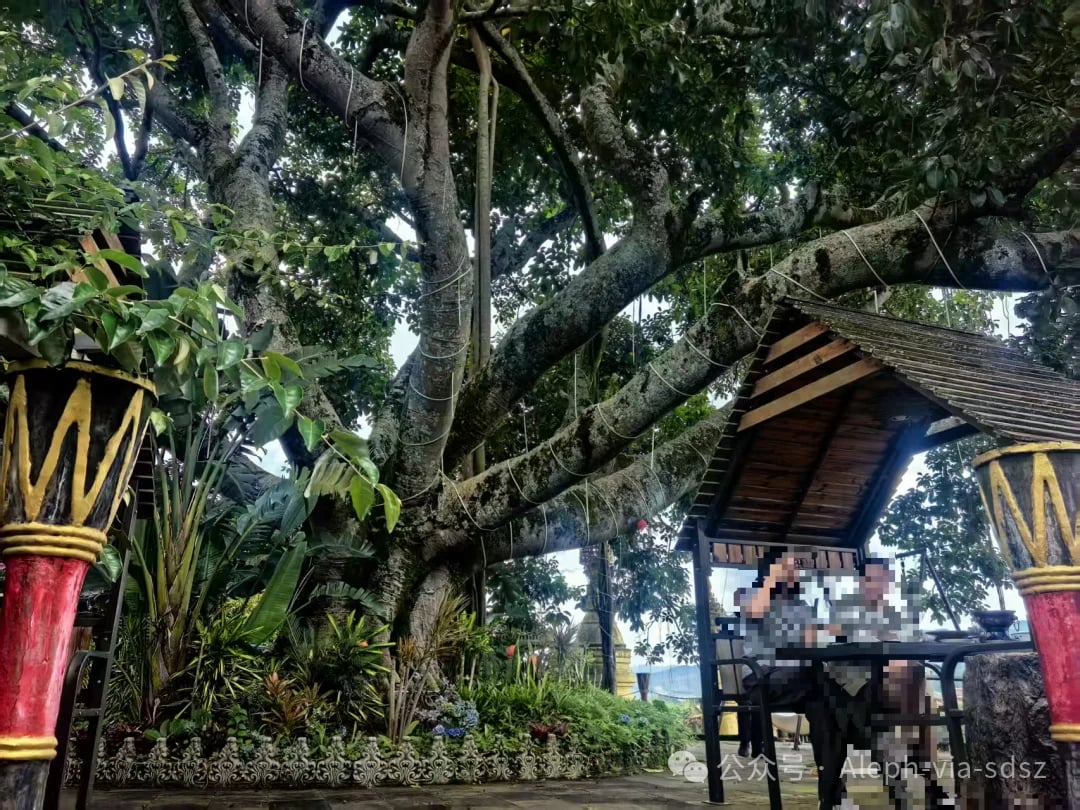
In Mangshi, Dehong, on the southwestern frontier of Yunnan, the vertical seams of geography profoundly discipline the forms that civilization takes. If one follows the winding mountain roads from the broad Mangshi basin up toward the cold highlands, a striking religious-ecological cross-section comes into view: in the valleys and plains, glittering Theravada Buddhist temples stand against lush Dai Longshan (“dragon hills” or sacred groves), protected for generations by taboo; farther up the slopes and into the mountains, brick churches topped with red-painted crosses rise above Jingpo villages.
What is startling is that around these crosses, the primeval forests that once sheltered villages and were regarded as inviolable domains of spirits have, over just a few decades, been fragmented by regimented macadamia plantations, terraced coffee fields, and modern roads.
This is a story of both “religious substitution” and an “ontological rupture” unfolding within the same geographic unit. Environmental historians and ecologists have long tended to explain the retreat of southwestern forests through external variables: state-led modernization of forestry, the lure of monocultural cash crops, and the spread of modern agricultural technologies. Yet in the field sites of Mangshi, the fate of trees and land has never been separate from the “sacred order” in people’s minds.
To truly understand the micro-mechanisms behind the “retreat of sacred forests and rise of the cross” in Mangshi villages, we must confront how Catholicism and Protestant Christianity, in the process of cross-cultural transmission, used an elaborate combination of institutional, theological, and sociological techniques to break apart indigenous animist orders and rapidly construct remarkably durable forms of religious loyalty.
I. Historical Depth: From Courtly “Accommodation” to Frontier “Structural Overturning”
Beneath the old ginkgo trees of Beijing’s Five Pagoda Temple stand more than thirty Qing-dynasty tombstones of missionaries. Their tops are carved with imperial-style twin dragons, yet at their centers appear the crucified Christ and the Jesuit IHS emblem. Beneath these stones once lay Joachim Bouvet, Jean-François Gerbillon, Michel Benoist, and other “King’s Mathematicians” dispatched by Louis XIV.
During the Ming and Qing dynasties, the missionary strategy represented by Matteo Ricci and the French Jesuits at the Forbidden City and Yuanmingyuan was a form of top-down scholarly accommodationism:
- Core strategy: Missionaries dressed as Confucian scholars and used Western astronomy and calendrics, geometry and mathematics, geodesy and cartography (such as the Kangxi Atlas), and hydraulic/mechanical engineering (such as the fountains of Yuanmingyuan’s Haiyantang) as gateways into service at the highest levels of the imperial court.
- Ritual compromise: To gain acceptance among emperors and scholar-officials, early Jesuits even treated traditional Chinese ancestor worship and Confucian rites as secular moral practices, doing their utmost to avoid directly challenging China’s kinship ethics and state order.
By the late Qing and Republican periods, however, missionary frontiers had shifted from the imperial court to the remote mountain valleys of Southwest China—the stateless uplands anthropologist James C. Scott famously called Zomia. There, the logic of missionary expansion underwent a fundamental paradigm shift: from elite-level “conciliation and accommodation” to “comprehensive empowerment and structural overturning” among marginalized populations.
At the time, the uplands of Mangshi lay between Dai tusi territories and the weakly administered margins of the central state. Indigenous highland peoples such as the Jingpo (Kachin) faced a triple structural crisis:
- Ecological and interethnic pressure: They lived in cold, infertile highlands and practiced swidden cultivation, while facing corvée extraction by lowland Dai rulers and economic pressure from Han migrants.
- Social disintegration: Inter-clan blood feuds lasting generations, the spread of opium in the late Qing period, and alcoholism eroded social cohesion and community capital.
- Tropical disease and spiritual fear: Malaria, cholera, dysentery, and other diseases were rampant. Without modern medicine, suffering was commonly attributed to unpredictable supernatural beings within an animist system overseen by ritual specialists known as Dumsa.
II. Where Did the Loyalty Come From? The “Grassroots Capture Mechanism” of Monotheism on the Frontier
Catholic missions such as the Paris Foreign Missions Society (MEP) and Protestant missions such as the American Baptists were able to gain intense and intergenerationally durable loyalty in these mountain forests not primarily because of the abstract logic of Western theology, but because they addressed immediate survival crises and offered a comprehensive “liberatory alternative.”
| Mechanism | Survival predicament under traditional animism | Monotheistic reconstruction and solution |
|---|---|---|
| 1. Ritual economy: from a “debt trap” to “absolute release” | High supernatural transaction costs: Traditional cosmology held that all things could be inhabited by spirits. Illness, famine, and difficult childbirth might be interpreted as offenses against spirits. Healing and protection therefore required ritual specialists such as the Dumsa to preside over animal sacrifices. Poor families might sell land or livestock to finance rituals, creating a cycle of “the poorer one is, the more one sacrifices; the more one sacrifices, the more one falls ill; the more one falls ill, the poorer one becomes.” | Theological equality and cancellation of ritual debt: Missionaries proclaimed that the one true God was omniscient and omnipotent, superior to all mountain spirits, and that Jesus Christ had already offered the sole sacrifice for humanity’s sins. Once baptized, believers no longer needed to sacrifice livestock to other spirits. Economically, this theology functioned as a radical “debt cancellation,” releasing poor households from ruinous sacrificial obligations. |
| 2. Symbolic capital: script creation and the awakening of ethnic subjectivity | Marginalization of an oral culture: Jingpo tradition lacked an indigenous writing system. History and ethics were largely monopolized by ritual specialists and chiefs, leaving the community at a severe institutional and cultural disadvantage in interactions with Han and Dai society and exposing it to contempt as “people without writing.” | “Genesis-like” empowerment through writing: Missionaries such as Ola Hanson developed a Latin-based writing system for Jingpo, translated the Bible, and compiled grammars and dictionaries. Indigenous people could, for the first time, read books written in their own language. The psychological shift from being treated as a “barbarous margin” to becoming “readers holding sacred scripture” generated powerful ethnic pride and intense attachment to the church. |
| 3. Bodily salvation: modern medicine as an overwhelming challenge to shamanic healing | Deadly malaria and the failure of ritual medicine: In the face of high-mortality tropical diseases, spirit-calling rituals and herbal therapies were often ineffective, leaving individuals with little protection. | Quinine and modern hygiene as “proof of the true God”: Western clinics, antimalarial drugs such as quinine, and practices such as clean drinking water produced visible improvements. In a pragmatic local logic, “the god who can cure malaria must be the true God.” The effectiveness of modern medicine could therefore be interpreted directly as evidence that the Christian God was more powerful than local spirits. |
| 4. Moral discipline: organizational reconstruction and fictive kinship networks | Fragmented clan society, feuding, and addiction: Clan structures lacked public mechanisms of cooperation beyond blood ties, while opium and alcohol consumed productive labor. | A highly disciplined community of “brothers and sisters in Christ”: Churches established strict rules against opium, alcohol, and gambling; promoted Sunday school, collective hymn singing, tithing, and fellowship; and built egalitarian fictive-kinship networks transcending clan lines. These networks reconstructed highly resilient grassroots systems of mutual aid. |
Even more important, monotheistic theology possesses a strong exclusivist dimension. Conversion did not mean simply adding one more god to an existing pantheon. It could require decisive rituals of rupture: publicly burning spirit altars, cutting divination cords, and removing household talismans.
This ritualized “complete break with the past” imposed high social sunk costs on converts and, in turn, helped forge a closed and remarkably resilient barrier of religious loyalty.
III. The Fate of Trees: Ontological Disenchantment and the Collapse of Sacred Forests
Here lies a profound anthropological paradox: a monotheistic religion that could be highly “liberatory” in terms of social organization and human welfare could also become, from the perspective of ecological anthropology, a force dismantling traditional barriers to environmental exploitation.
1. The Thorough “Disenchantment” (Entzauberung) of Animist Ontology
In the traditional Jingpo cosmology of Mangshi, humans are not rulers of nature but one element within a complex multispecies network. Drawing on anthropologist Philippe Descola, animism recognizes nonhuman beings—animals, mountains, ancient trees—as possessing forms of “soul” and “subjectivity” comparable to those of humans.
- Sacred forces associated with wind and rain inhabit the mountains and forests, including figures such as the Jingpo deity Madai and various mountain spirits.
- Sacred forests, or Numshang, form domains where unauthorized logging and cultivation are absolutely prohibited.
- If someone cuts down a sacred tree or contaminates a water source, not only may that individual fall gravely ill, but the entire village may suffer drought or famine sent by offended spirits.
Traditional ecological order was therefore maintained through an internalized combination of supernatural awe and collective fear of social consequences.
2. From a “Symbiotic Covenant” to “Iconoclasm”
Monotheistic doctrine could break this reverence in radical ways. Within creation theology and exclusivist teaching:
- Nature is reduced to created matter: God transcends nature; trees, mountains, and rivers, as created things, possess no sacred status in themselves.
- Mountain spirits are reclassified as demons: Traditional animist beliefs are condemned as “idolatry” or as the domain of “the Devil” or “Satan.”
During the fervor of early conversion, felling a once-feared sacred tree or leveling a grove that had previously been forbidden territory no longer appeared as a taboo likely to bring catastrophe. Instead, it could become an act through which believers demonstrated to the entire village the firmness of their faith and their rejection of what missionaries defined as Satanic superstition.
When the first sacred tree was cut down and the woodcutter did not immediately die, a supernatural ecological defense built over centuries could collapse almost instantaneously at the psychological level.
3. The Failure of “Stewardship Theology” and the Unimpeded Advance of Market Capital
In modern Western Christianity, Stewardship Theology developed the idea that humans are entrusted by God to manage and protect creation. Yet when Christianity entered the southwestern frontier, this theology was not necessarily absorbed deeply by grassroots believers. In missionary practice, the urgency of eschatological salvation—saving souls for heaven—often outweighed concern for the material environment.
Once sacredness was stripped from nature, forests could rapidly be reclassified as ownerless objects or secular means of production. As modern market forces entered western Yunnan through the expansion of macadamia, Arabica coffee, sugarcane, and rubber, few internal religious taboos remained to prevent villagers from converting ancient sacred hillsides into terraced cash-crop plantations.
The authority governing ecological behavior thus shifted from the “judgment of the gods” to the “ledger of the market.”
IV. Multiple Mirrors of Mangshi: A Micro-Level Contest among Three Ecological Orders
Field observation in Mangshi reveals three ecological cross-sections shaped by the interaction of distinct civilizational forces. Together, they form a highly suggestive comparative experiment:
| Spatial cross-section | Faith and dominant authority | Ontological view of nature | Present-day ecological landscape |
|---|---|---|---|
| Traditional Dai villages on the plains | Theravada Buddhism + indigenous beliefs in territorial spirits / Longshan sacred groves | Sacred protection and merit-making: Buddhist temples and Longshan coexist; protecting sacred forests is believed to accumulate merit and safeguard village water sources. | Tall, lush stands of native evergreen broadleaf forest remain behind villages as Longshan, with clearly defined ecological boundaries. |
| Converted Christian villages on middle slopes | Protestantism / Catholicism + modern village committee governance | Thorough disenchantment and a pragmatic resource view: Sacredness is transferred to God and the church; forests are regarded as private economic assets belonging to households. | Sacred groves have largely disappeared, and the landscape is covered by macadamia orchards, coffee plantations, and other cash crops; biodiversity has been significantly reduced. |
| Cold highland villages retaining traditional belief | Surviving animist traditions, including Dumsa ritual practices | Taboo maintained through awe and fear: Fear of offending mountain spirits preserves strict clan boundaries around sacred forests. | Forests are partially preserved, but with modern education and the out-migration of young people, the taboo system faces the danger of disappearing for lack of successors. |
V. Conclusion: Moving Forward amid Historical Trauma and the Dilemmas of Modernity
The field landscape of Mangshi reveals a deeply troubling paradox of modernity on the frontier.
We cannot simply stand on the moral high ground of romanticism and condemn the decision of frontier peoples who once chose the cross over the sacred grove. For highland communities trapped in clan warfare, endemic disease, and crippling sacrificial debt, the writing systems, medicine, anti-addiction discipline, and more egalitarian communities brought by foreign religions could amount to a very real “liberation of survival.”
Yet neither can we ignore the ecological price of that liberation. When divinity withdraws entirely from the forests, and when an ancient cosmology that understood humans and other beings as sharing a form of equality is replaced by a Western anthropocentric view of nature, humans may also sever their deepest spiritual umbilical cord to the land.
In the dusk of Mangshi, church bells and Buddhist chanting echo through the valleys. Standing at the boundary between flattened macadamia plantations and the remaining Longshan groves, one is compelled to reconsider a fundamental question about the future:
Beyond the powers of science and administration, can humanity, on an earth from which the gods have departed, rediscover a heartfelt humility and reverence toward all living beings?