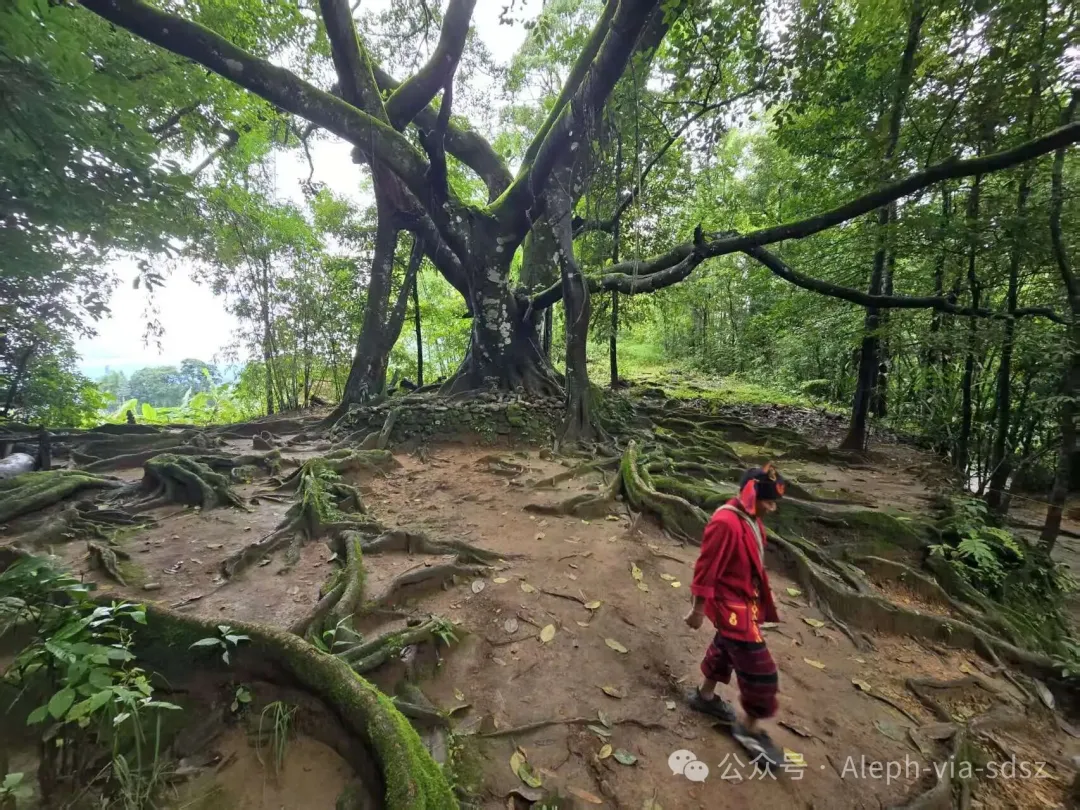
Standing before the dense forest on the hillside behind the Old Village of Wengding, the scene that unfolded before my eyes completely shattered the assumptions I had formed at my desk prior to the fieldwork.
In my initial speculation, the encroachment of modern administrative and market forces upon the frontier’s primeval sacred forest should have been accompanied by stark, confrontational traces: rusty galvanized barbed wire, concrete forest boundary markers, or warning signs painted in bright red letters reading, “Illegal logging strictly prohibited; violators will be fined in accordance with the law.”
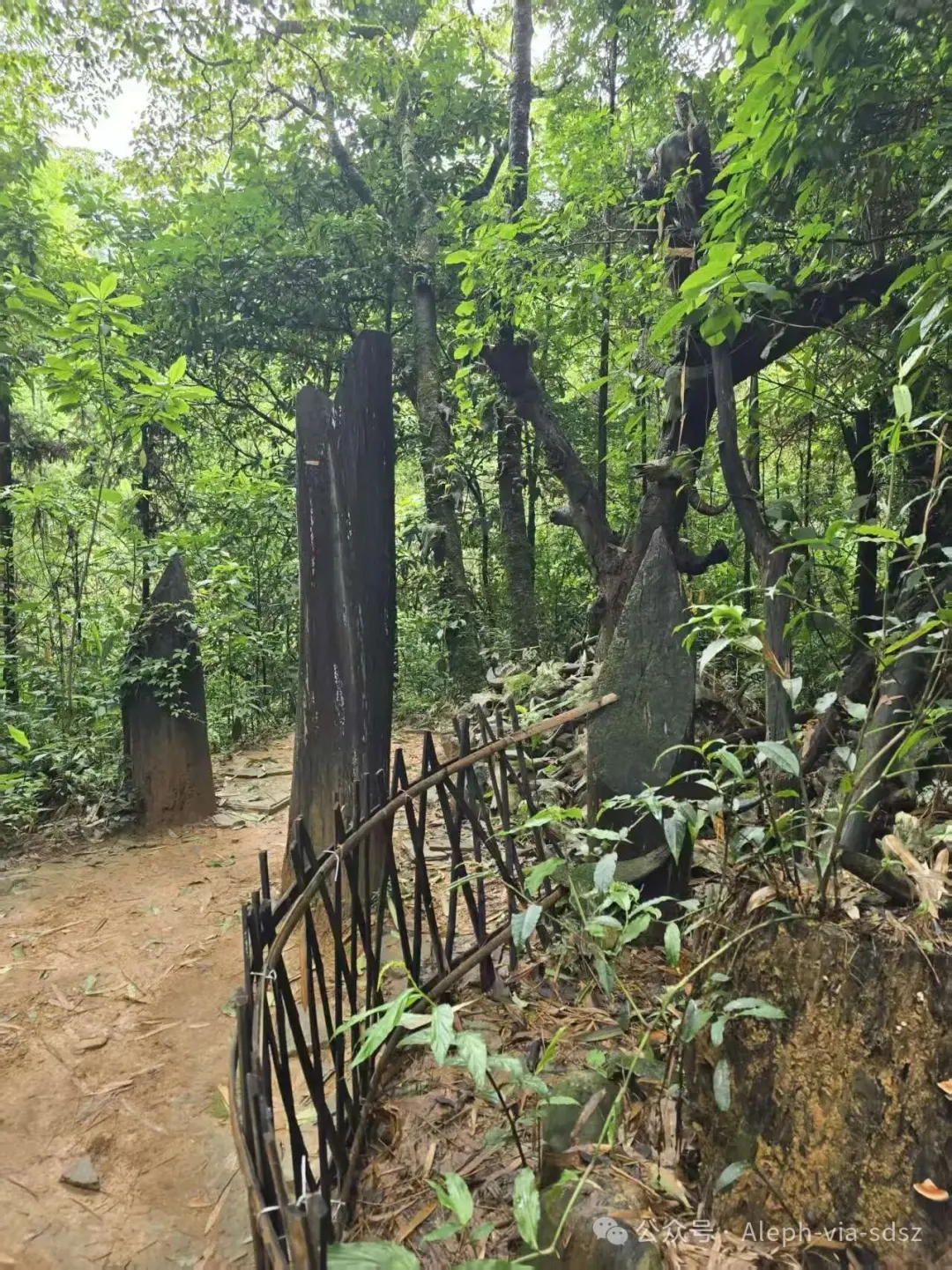
But on the ground, there was neither barbed wire nor harsh administrative fines. What stood between the forest and the outside world was a smooth, neatly maintained log fence. Beside the fence stood a neat and elegant dark wooden signboard, on which, in neat modern Chinese characters, the spiritual affiliation of this land was explained in detail to visitors: “This is the Wa people’s traditional sacred forest for worship…”
This scene constitutes the most thought-provoking cultural metaphor of Mount Awa: the sacred forest has not vanished under the bulldozers, nor has it been violently expelled by administrative orders; rather, it has been “heritagized” and “museumified.” The supreme deity, who for millennia has governed the tribe’s reverence for life and death, has been gently ushered into a wooden fence by the modern cultural tourism system and co-opted as a harmless “folklore information sign.”
To understand this gentle displacement of sacredness, one must first return to the ancient spatial topology of Mount Awa.
I. The Topology of Space: Sacred Trees, Sacred Forests, and Hierarchical Taboo Landscapes
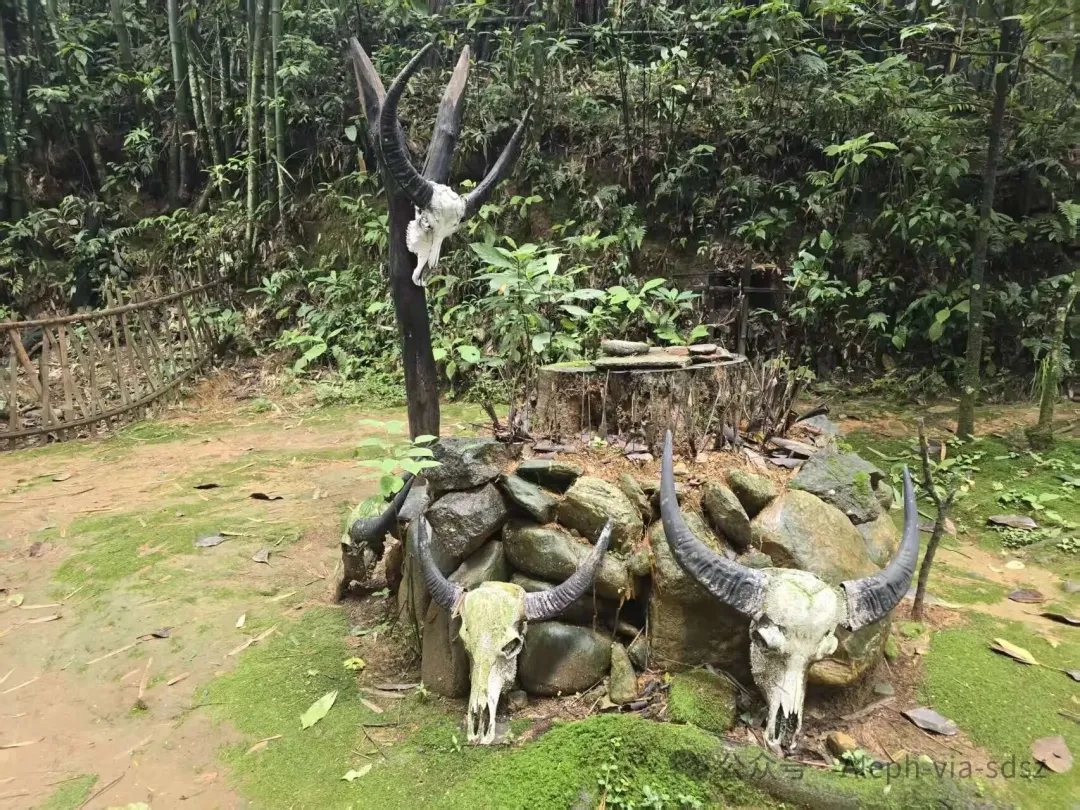
The logic of modern Western ecological governance is, at its core, a Cartesian geometric demarcation: draw a clear red line, with the area inside being an inviolable “nature reserve” and the area outside a secular production zone open to human development. When we search for the “ghost forests” of Wa villages through this “either-or” binary framework, we often find ourselves at a loss, because the first thing that catches our eye in the village is rarely a vast, continuous forest, but rather a massive ancient banyan tree hung with weathered bull skulls.
This does not signify a shrinkage of traditional ecological space, but rather reveals the true scale of the Wa people’s traditional environmental order—it is not a flat, geometric partition, but a topological network of rituals, nested layer by layer from the inside out:
1. Points: Sacred Trees and Village Poles
The “Gemán” (village stake) in the central square serves as the village’s cosmic axis (Axis Mundi), while the ancient banyan trees scattered throughout the landscape stand as living monuments to clan history and ancestral memory. In Wengding and the Moon Ancient Village, sacred trees are never isolated “plant landscapes.” Specific families often designate a particular large banyan tree as a sacred space exclusive to their lineage; red ropes and ox heads are tied to its massive buttress roots, and with its immense vitality, the tree bears the entire clan’s heritage and foundations.
2. Line: The Wooden Drum House and the Village Gate Boundary
The inner and outer boundaries of the village are defined by the wooden drum house (Keluo), where the sacred musical instruments are kept, and the village gate. During the Village Protection Festival, the Moba leads the villagers in twisting a long, thin, rough straw rope, which they then wrap completely around the village boundary. This grass rope is physically fragile, yet ontologically it forms a strict boundary: on the day it is completed, the village enters a “sacred closed period” (封闭期), and both wandering evil spirits and outsiders are barred from entering the realm of order.
3. The Realm: Sacred Forest “Longmeiji”
Hidden deep within the dense forests behind the village, this is the dwelling place of the supreme deity “Moyiji.” Here, there is none of the clamor of daily labor; only the ritual hall lies concealed beneath the dense shade of towering trees. Ordinary villagers are strictly forbidden from entering without permission, let alone breaking branches or disturbing the soil.
4. The Realm: Mountains and Waters Intertwined
Radiating outward from the sacred tree, the grass ropes, and the sacred forest, terraced fields, water-source forests, and streams unfold in an orderly fashion.
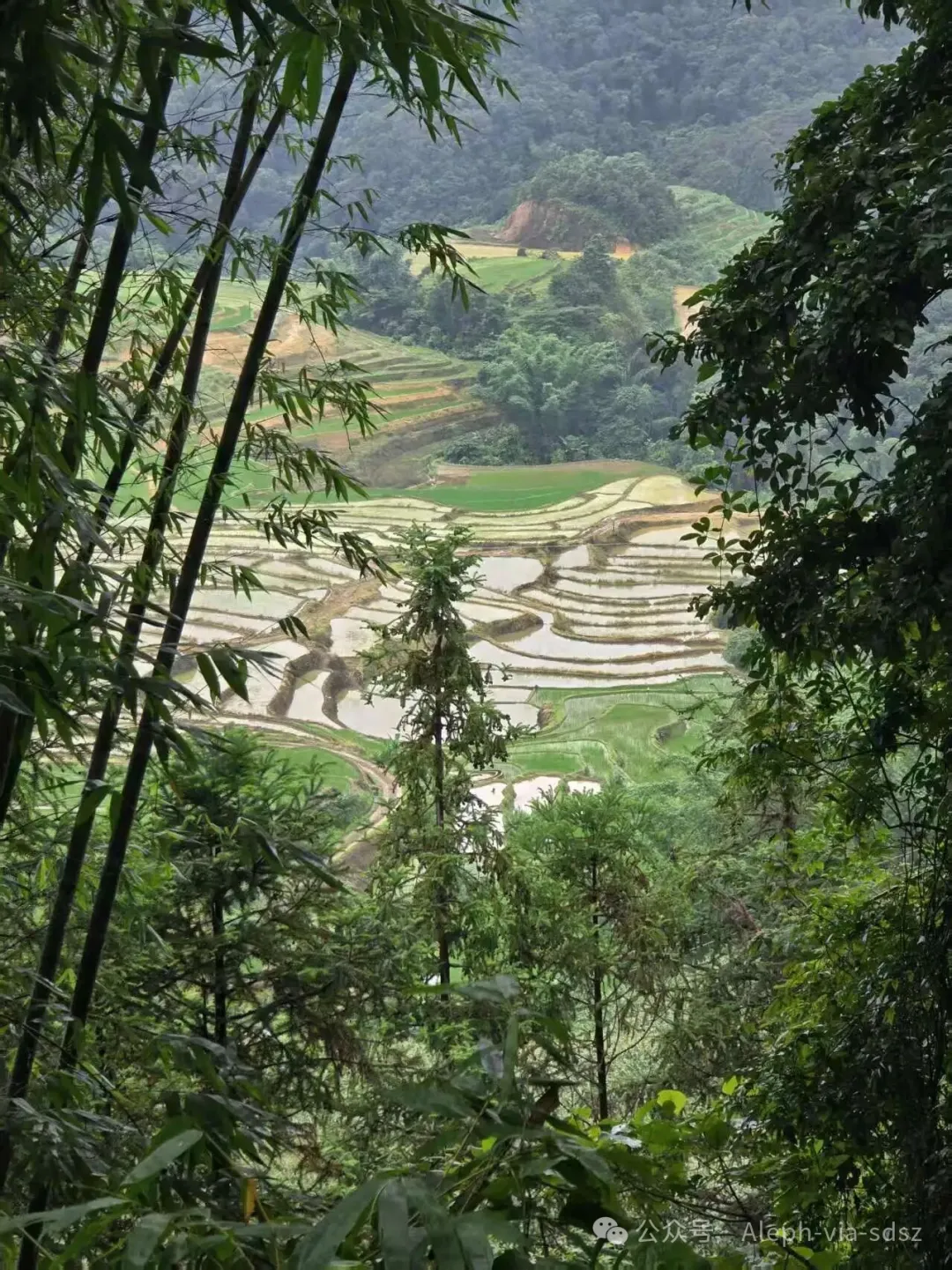
In the traditional Wa cosmogony, nature is not a “resource bank” waiting to be exploited, but a living network teeming with taboo nodes. The maintenance of the ecosystem depends entirely on the inviolability of this multi-scale system of sacred spaces.
II. The Court of Order: “Awa Li” and the Unfathomable Divine Power of Mu Yiji
When examining the traditional ecological concepts of ethnic minorities, outsiders often tend to view them through a romanticized lens, interpreting them as a conscious environmental awareness of “harmonious coexistence between humans and nature.”
But deep within the Awa Mountains, the reality is far harsher. The Wa people’s generations-long protection of sacred trees and forests stems not primarily from a rational, conscious commitment to “preserving biodiversity,” but from a deep-seated fear of supernatural divine retribution.
The Wa people’s supreme deity, “Mu Yiji,” is not a gentle and benevolent creator, but rather an absolute force—stern and elusive—that pervades the heavens and the earth. He controls the weather, harvests, and the fortunes and misfortunes of the people. Under “Awa Li,” the tribal customary law followed for generations in the Awa Mountains, trespassing into the sacred forest or felling the sacred trees that sustain the water sources is by no means a mere violation of forest protection regulations; rather, it constitutes “spiritual treason” that endangers the safety of the entire village.
Whenever an unusual epidemic broke out in the village, a severe drought struck, or livestock died suddenly, the priest, “Mo Ba,” would use chicken bone divination or pig gallbladder divination to determine the cause of the disaster—the conclusion often pointed to someone having crossed the boundary of the sacred forest and angered the deities.
This is immediately followed by the rigid punishment mechanism of “Awa Li”: the offender must apologize and accept punishment, with the family bearing the cost of expensive sacrificial offerings (historically, the headhunting ritual was fully replaced after the founding of the People’s Republic with the grand “ox sacrifice” ceremony) to appease the gods’ wrath with blood and restore cosmic balance. Anyone who refuses to comply faces isolation—cut off from all ties with the village—and complete expulsion.
Fear formed an insurmountable ecological defense line. When the price of recklessly felling a single tree was financial ruin and divine retribution, no axe dared to fall lightly. This governance mechanism, rooted in supernatural judgment and tribal collective responsibility, is precisely the underlying secret behind the ancient trees of Awa Mountain thriving for thousands of years.
III. A Cross-Section of Two Villages: The “Embers of Daily Life” in Moon Ancient Village and the “Spatial Disembedding” of Wengding
The encroachment of modernity is not a monolithic phenomenon. In the fields of Cangyuan, Moon Ancient Village and Wengding exhibit strikingly different spatial textures, forming two vivid cross-sections of the evolution of the sacred order:
1. Moon Ancient Village: Sacred Trees Amid the Smoke of Daily Life and Living Practicality
Unlike Wengding, which was developed through comprehensive planning, the indigenous residents of Moon Ancient Village continue to live year-round at their original site. Here, the sacred trees are not enclosed by fences but are deeply rooted in the daily lives of the villagers.
- An Anchor of Daily Life: A towering ancient banyan tree takes root beside the dirt road in the center of the village; beneath it lies a communal space where elders rest in the shade and smoke, and children chase each other and play. The sacred tree is not only a spiritual symbol but also retains practical, everyday uses: when a child in the family suffers from a prolonged illness or an elder falls ill, villagers still walk to the tree to place a bowl of rice wine and light incense to pray for protection; during festivals or upon returning from a long journey, people often pause before the tree to offer silent prayers.
- Self-Discipline Within Micro-Boundaries: Because people live side by side with the tree day in and day out, ancient taboos have not completely faded away: elders still sternly warn children not to urinate or make a racket under the sacred tree, and stripping the bark is still regarded as an ominous sign that invites disaster.
- The Encroachment of External Economies: The crisis of sacredness here does not stem from the exploitation of cultural and tourism landscapes, but from the encroachment of external cash crops. The gentle slopes surrounding the village have been fragmented into disjointed patches by expanses of high-yield macadamia nut plantations, sugarcane fields, and terraced tea gardens. While villagers maintain their reverence for the sacred tree within the village, when clearing land outside its boundaries, they have quietly learned to “bargain” with the spirits at the periphery of the sacred grove using simple prayers and economic ledgers.
2. Wengding: Post-Disaster Relocation and Complete “Spatial Disembedding”
Following the 2021 fire in the old village, Wengding embarked on a radically different path: the indigenous residents were relocated en masse, and the old village was completely sealed off and transformed into a ticketed cultural tourism site.
- The physical separation of sacred objects from daily life: Villagers moved into a modern, brick-and-concrete village at the foot of the mountain, fully equipped with amenities. Although the sacred tree, the wooden drum house, and the ox-head stakes in the old village were all restored, they were left permanently on the mountain. Not a wisp of smoke from firewood used for daily subsistence remains in the old village, and the sacred tree has been completely severed from the villagers’ life cycle—from weddings and funerals to birth, aging, sickness, and death.
- The Dramatic Reversal of Function (From Protecting Villagers to Pleasing Tourists): In the Moon Ancient Village, the sacred tree served to protect the local villagers; in Wengding, however, its function has shifted to providing outsiders with a vision of exotic charm. Early in the morning, villagers from the new village “clock in” at the old village as if heading to work. They change into traditional ceremonial attire and, in front of the sacred tree and the wooden drum house, perform the wooden drum dance and demonstrate weaving for crowds of tourists right on schedule. The sacred musical instruments, once filled with awe and reverence, have become mere background noise amid the tourist area’s public address system and the clicking of camera shutters.
- A reversal and taming of perspectives: In the past, the Mu Yiji deep in the forest watched over and disciplined humanity; today, tourists stand outside the log fence, peering through their sunglasses at the “Traditional Sacred Forest Explanation” printed on a wooden sign, using their cameras to consume a safe cultural exhibit.
IV. Deities Tamed by Information Signs
Modernity’s dismantling of ancient sacred orders has never relied solely on violence.
In the high-mountain villages of Mangshi, an imported monotheistic religion, under the banner of “smashing idols,” declared traditional sacred groves to be the abodes of Satan and demons, encouraging believers to chop down sacred trees with axes—thus completing a radical “religious replacement.”
What Cangyuan demonstrates, however, is another, more covert yet thorough mechanism—“gentle co-optation and heritage preservation.”
Instead of felling the sacred trees, it has built exquisite pedestals for the ancient trees; instead of leveling the sacred grove, it has erected neat log fences around the perimeter, accompanied by detailed Chinese inscriptions providing cultural explanations. Yet it is precisely within this seemingly civilized and scientific logic of presentation that Mu Yiji has been thoroughly stripped of his status as an “ecological legislator.”
An information plaque, using objective and rational modern language, deftly translates a system of awe-inspiring laws—concerning the covenant between life and death and cosmic judgment—into harmless “local intangible cultural heritage folklore.” Tourists walk past the fence, nod in acknowledgment, take photos, marvel at the unspoiled natural setting, and then leave without a second thought.
As twilight envelops the ancient village of Wengding, the daytime bustle fades, and the villagers who performed the rituals board buses to return to the modern new village at the foot of the mountain. The setting sun filters through the dense canopy of a century-old banyan tree, casting dappled light across the empty, deserted stone-paved square. The sacred forest within the wooden fence remains as lush and mysterious as ever, but that inner awe—which once caused axes to pause mid-swing—has, along with the daytime information signs, been permanently consigned to the display cases of modern civilization.