Late at night, the light from the desk lamp cleanly sliced my shadow onto the wall, while a pile of winter break assignments for my freshman year in the International Department sat at the corner of the desk, looking barely touched. I looked at my reflection in the glass window: a "good student" who is always emotionally stable, clearly organized, and actively cooperative during the day. In a precisely calculated system of order, I seemed to be merely a well-functioning cog.
But I knew there was something else hidden within that shadow—a certain instinctive vigilance against the "established order." It disliked these step-by-step tracks; it indulged in wanderings that offered no help toward college admissions, capable of spacing out at the tree shadows outside the window for an entire study hall, or perhaps getting lost for an evening under a newly bought fluffy blanket after coming home. When everyone else's blood was boiling for collective honor, it would always inappropriately drift off, stubbornly guarding its own somewhat selfish territory. Just as Kierkegaard once warned, "The crowd is untruth," my shadow refused to dissolve into the homogenized frenzy. During this winter break, which demanded spending "a winter accompanied by literature," without exception, it was still here, manifesting as procrastination in the face of assignments. But my shadow deserves to be recorded in an essay, documenting the true moments of crossing inner borders with this "shadow" and establishing a sense of self within a massive external structure.
There is a poorly composed photo in my phone's gallery. More than half the frame is taken up by a bleak and cold car window frame, and only through the extremely narrow gap at the corner does a hint of almost wild sunset glow peek through.
That was taken on Chang'an Avenue. My original plan that day was quite pure: to escape all pressure and go to the countryside to watch a complete sunset. By the time I woke up, the sun was already high; I packed the bags that had been a mess for days due to my procrastination, sorted out my emotions, and was ready to start doing "truly meaningful things," ready to enjoy a rare holiday. In the car, I habitually began to fantasize: the sun should start setting just as I arrive at the homestay; oh right, after watching the sunset, going out for dinner will be the perfect time to stargaze!
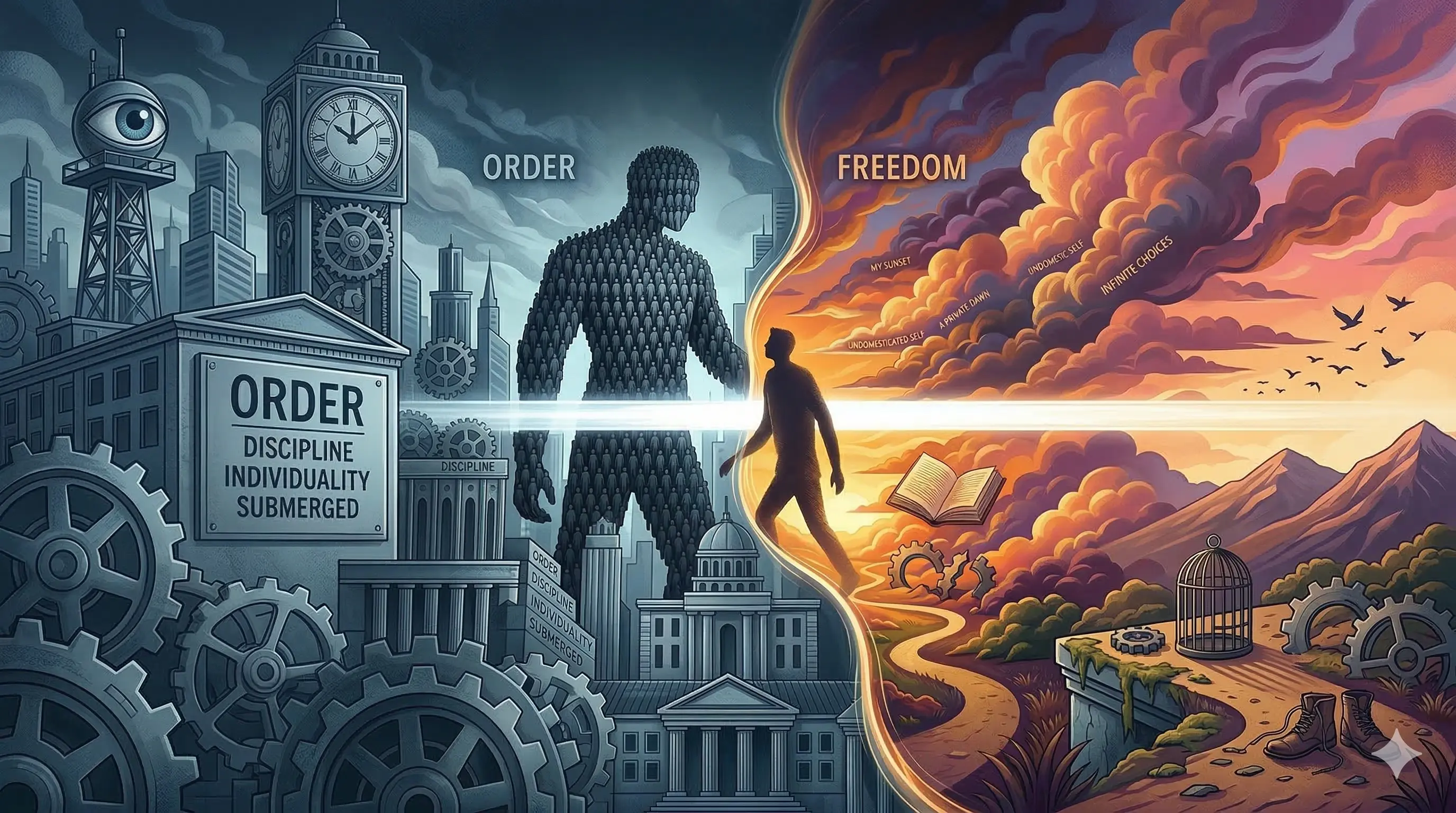
But when the car drove near Tiananmen, everything came to a screeching halt. The flag-lowering ceremony was about to begin, and a pause button had been hit on the entire street. This was a Hobbesian "Leviathan" moment—at this instant, the minuscule trajectory of the individual had to unconditionally give way to an irresistible, grand political and spatial order.
The car was deadlocked in place. Outside the window, everyone was standing solemnly and gazing; that grand atmosphere was indisputable. It was an absolute domination of time and space. Yet I shrunk back into the narrow backseat; there was no awe in my heart, only the anxiety of having my plans disrupted. Through that dusty gap in the car window, like a miser, I desperately tried to grasp that little bit of the setting sun on the horizon—the one that belonged to me—as it was being swallowed by the high-rises. That was the only personal freedom I could preserve amid this grandiose stillness. I refused to surrender my gaze to this massive order; I chose to look at my private dusk.
This feeling of being "trapped" is actually more covert and far more common in the daily life at school.
At the opening ceremony, the cheers on the sports field were so uniform they were almost suffocating; people around were sweating, getting excited, and everyone was being assimilated by that immense enthusiasm. Here, the micro-power field revealed by Foucault in Discipline and Punish materialized: the order demanded not only the presence of the body (docile bodies) but strictly demanded the synchronization of emotions as well. Sitting on the field, I blamed the ruthlessness of the sky for begrudging us even a single cloud. I merely felt that everything around me was high-frequency noise; at that moment, my shadow silently conceded defeat in my heart, but it also silently went on strike.
I even secretly calculated in my head: if I could save the time spent shouting slogans, I could probably finish two chapters of a novel, or reminisce again about the sunset I missed that day. It's not that I don't know how to be moved; I just don't want even my personal senses to be forced into a unified march. That "freedom not to be moved" is the final territory I want to defend as an independent individual. When being moved becomes an order mandated by the system, apathy becomes the only means of self-defense for subjectivity.
I gradually realized that growing up doesn't necessarily mean carrying a sense of "guilt" to completely erase that somewhat indifferent "shadow." I embraced it. It is exactly this untimely shadow that preserved a trace of personal dignity for me on the jammed Chang'an Avenue and on the noisy sports field.
I seem to have reached a secret complicity with it: I will appear on the sports field on time, I will politely respond to the callings, and I will continue to be a high school freshman who meets expectations. But in my heart, I will always keep that photo of the rosy clouds with only a narrow gap—that is the passport to my inner freedom. True growth is perhaps not forcing oneself to blend into every overwhelming shock, but learning to stay sober at the center of the shock—to preserve a clear-headed heterogeneity at the core of absolute order.
On this winter night during the break, outside the window is only the dry, cold Beijing wind. According to the requirements, this winter assignment must "demonstrate personal growth." I suppose my growth is no longer trying to eradicate my shadow and, after experiencing setbacks, become a flawless Prince Myshkin, a perfect model in the history of growing up (in other words, no longer obsessing over becoming a specimen of perfection in both morality and order). Rather, it's having learned how to protect that untamed self, finding a tranquil resting place for the darkness.
Carrying that gap that belongs to me, I will continue moving forward. Within that gap, my sunset will never extinguish.
Reference
- Søren Kierkegaard: "The crowd is untruth." — A core existentialist concept emphasizing that truth and moral responsibility reside within the individual, whereas the collective mass often breeds conformity and suppresses true subjectivity.
- Thomas Hobbes, Leviathan: The "Leviathan moment" refers to his concept of the absolute, overarching power of the state (or a grand political/spatial order) to which individual trajectories must unconditionally surrender in exchange for order.
- Michel Foucault, Discipline and Punish: The references to the "micro-power field" and "docile bodies" illustrate how institutional structures exert invisible, disciplinary power to shape, train, and enforce uniformity upon not only physical bodies but also emotions.
- Fyodor Dostoevsky, The Idiot: The mention of "Prince Myshkin" serves as an archetype of the morally flawless, almost saint-like individual—a perfect model of growth that the author decides is unnecessary to obsess over.