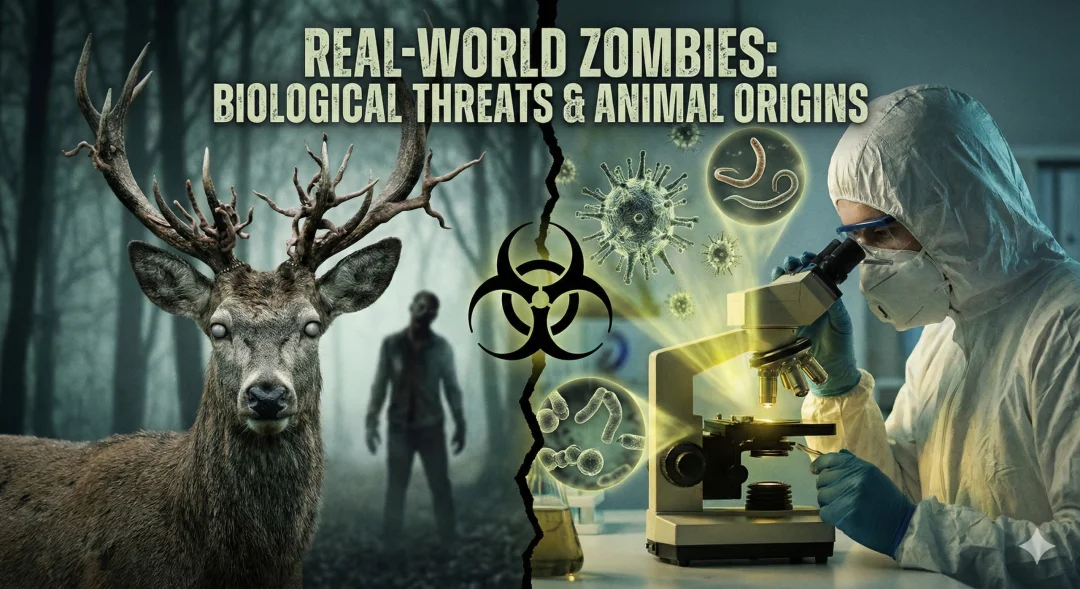
There is a scene that hasn't happened in the human world yet, but it has already appeared in the animal kingdom. We talk about the "Zombie Project"—people might think it’s impossible, but there are actually several ways a zombie outbreak could happen.
First, there are the tropes from movies and stories:
Aliens: Zombies created by extraterrestrial organisms.
Magic: Reanimated corpses brought back by spells.
Specific Types: Herbivorous zombies that only eat plants, or even "Zombie Chickens."
Then, there are the versions with more scientific grounding, which are more unsettling:
Pathogens: Zombies caused by viruses or parasites.
Radiation: Creatures created after human biology is destroyed by nuclear fallout.
Lab Failures: Biological entities stripped of higher consciousness in a lab—the tragic products of failing to control the brain and nervous system.
Drug-Induced: "Zombie-like" humans caused by synthetic drugs, such as the "Miami Face-Eater" incident.
Pathogen-induced and radiation-induced zombies are the ones we should actually pay attention to. In fact, zombie-like symptoms caused by pathogens have already broken out in deer. This is caused by Prions. It makes the deer act weird, although they don't attack humans yet.
Then there is Rabies. It has a high mortality rate and progresses very fast after a human is bitten, which is why we don't see "everyone biting everyone" in real life. Because the infected either die or suffer nerve damage and paralysis, they don't become a massive threat to society. However, if a "mad scientist" engineered a version with a longer incubation period while keeping the host’s aggression, it could cause real harm and would be very hard to control.
Also, if zombies ate raw meat, they would eventually die from diseases anyway because of how human physiology works.
Nature already has similar phenomena:
Leucochloridium: A parasitic worm that controls snails.
Hairworms: These can control grasshoppers and force them to jump into water.
Fungus (Cordyceps): Spores infect an ant. Instead of attacking plants, the fungus controls the ant to climb to a high spot and bite down hard on a leaf vein. The fungus then feeds on the ant’s body to grow a fruiting body and spread more spores.
Right now, parasites and fungal zombies are hard to control in the short term. On the other hand, "maniacs" caused by chemicals (like the Miami case) might be studied by extremist groups to attack people in the future. However, because this isn't a "biological infection" that spreads from person to person, the speed and scale wouldn't be as crazy as what we see in movies. These cases are much easier to contain.