
Introduction: From a Visit to a Question
Last week in Beijing, I walked through the historic Modeshikou (模式口) area in Shijingshan District. I visited Fahai Temple, famous for its exceptionally preserved Ming Dynasty murals, Cheng’en Temple, and finally, the tomb of Tian Yi, a powerful imperial eunuch.
At first, it felt like an ordinary cultural walk. But soon, a deeper question began to emerge:
Why is there such a high density of high-level, imperial-grade temples in what appears to be a peripheral area of Beijing? What kind of political, spiritual, and social logic produced this unusual landscape?
This essay expands that curiosity into a broader inquiry: By comparing the temples of Modeshikou with medieval European churches and modern American community churches, I attempt to understand how sacred architecture functions as a tool of power, memory, and social organization.
In a Foucauldian sense, these religious spaces should not simply be interpreted as “buildings of belief,” but as spatial manifestations of political rationality.
I. Modeshikou and the Jingxi Ancient Road: Geography as Destiny
Modeshikou sits along the Jingxi Ancient Road (京西古道), a historic route that connected western Beijing to the capital’s political heart. For centuries, coal, stone, timber, tribute goods, monks, officials, and imperial processions passed through this corridor.
According to the historian Mark Elvin, transportation routes in imperial China often structured not only the economy, but also the religious and symbolic geography of a region.
Even more importantly, from a traditional Chinese cosmological perspective:
- The East = birth + rising sun
- The South = power + prosperity
- The Center = imperial order
- The West = decline, death, transcendence, Pure Land
The Western Hills (西山) and the regions around them were historically associated with Buddhism, retreat, and the afterlife realm — particularly connected with Amitabha’s Western Pure Land (西方极乐世界).
So Modeshikou is not simply “west of the city.” It is a symbolic frontier between political order and spiritual transition.
This makes it comparable to:
- Canterbury in England (pilgrimage nexus, not political capital)
- Santiago de Compostela in Spain
- Mount Kōya in Japan
These places do not derive sacredness from political power, but attract political power because of their perceived sacredness.
This phenomenon is known in religious geography as:
“The strategic sanctification of transit space.”
Modeshikou therefore became a ritual corridor, not just a traffic corridor.
And where there is sacred movement, temples follow.
II. Why Are These Temples So “High-Level”?
Among all the sites, Fahai Temple (法海寺) is perhaps the most perplexing.
Despite its modest scale, its murals are considered among the finest of the Ming Dynasty — comparable in technical sophistication to those in the Forbidden City.
This strange contrast – small space, enormous quality – is not accidental.
Historically, Chinese temples generally fell into two categories:
- Imperial temples — directly sponsored or sanctioned by the throne
- Folk/Local temples — sponsored by merchants, clans, or villages
Fahai Temple belongs to a third, more Ambiguous category:
Temples funded by elite intermediaries: eunuchs, imperial agents, court-connected families.
These people were technically “servants,” but functioned as parallel political actors.
Unlike European cathedrals, which visibly display royal or papal authority (e.g., Notre Dame, St. Peter’s Basilica), Ming Dynasty temples often hid power behind devotion.
This is a core difference between:
- Western monumental power (visible dominance)
- Chinese aesthetic power (concealed hierarchy)
As Pierre Bourdieu would describe it, this is not “direct power,” but symbolic power embedded into cultural capital.
The temple becomes:
- A religious space to commoners
- A moral disguise to its patron
- A symbolic extension of the empire
Power, in China, rarely shouts. It whispers through art.
III. Eunuchs and Temples: The Politics of Immortality
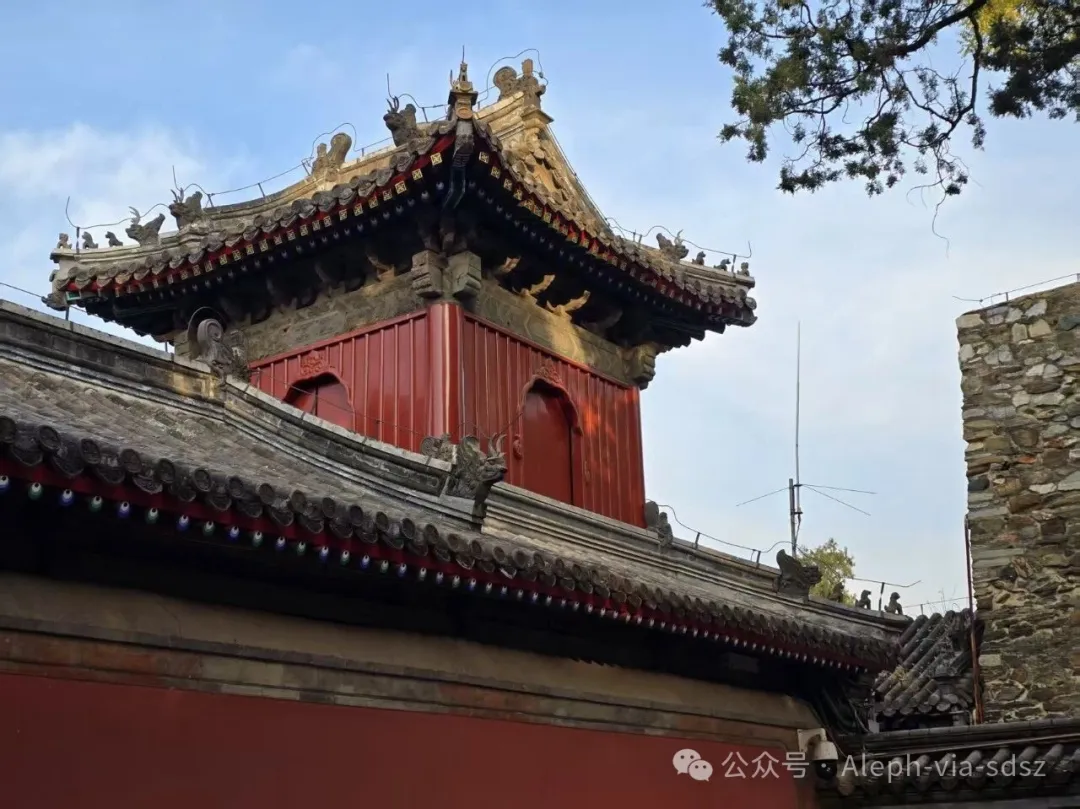
The most striking site in Modeshikou is Tian Yi’s tomb.
Tian Yi was a eunuch — no descendants, no bloodline, no ancestral continuity. According to Confucian tradition, this is the ultimate tragedy.
And yet, his tomb is monumental. In fact, it is one of the largest and best-preserved eunuch tombs of the Ming Dynasty.
Why?
Because for eunuchs, religion replaced bloodline.
They built:
- Temples
- Pagodas
- Tombs
- Altars
Not for reputation — but for posthumous existence.
In their case, temples became a technology of immortality.
This is remarkably similar to:
- Medieval European nobles who founded monasteries to ensure prayers for their souls
- Renaissance families who paid for church chapels (e.g., the Medici Chapel)
- Islamic waqf architecture to preserve names eternally
Sociologist Max Weber considered these acts examples of:
“Salvation economy through symbolic capital.”
But in Ming China, the system was even more extreme. Eunuchs built temples not only for salvation, but also to justify, morally and cosmically, their extraordinary political authority.
Thus, temples in Modeshikou are not just religious spaces — they are architectures of redemption and self-authored history.
They are history written in stone by men who had no bloodline to write it for them.
IV. Neighborhood Culture & Sacred Space: China vs. America
One huge difference appears when we compare Chinese temples with American churches.
In China:
You don’t “join” a temple. You visit it. You don’t “convert.” You participate.
A temple historically functioned as:
- Local court
- Market
- Education center
- Theatre
- Clock of agricultural time
- Festival center
- Moral education system
The Chinese religious tradition is syncretic. Confucian ethics + Taoist cosmology + Buddhist salvation.
This created what anthropologist Fei Xiaotong called:
“A differential mode of association” — where belonging is relational, not institutional.
In America:
You belong to a church. It is closer to a club + moral community + identity system.
The American church is:
- Membership-based
- Belief-defined
- Organizationally structured
This reflects the American idea of:
“Chosen community” rather than inherited community
In contrast, the Chinese temple reflects:
“Inherited space rather than chosen belief”
This might explain why, in China, you can remove belief and the temple still stands. But in the U.S., remove belief, and the church disappears.
V. Comparative Summary
Core Role:
- Modeshikou Temples: Political + cultural + sacred
- European Churches: Religious + state power
- American Churches: Social + religious
Patron:
- Modeshikou Temples: Eunuchs & court actors
- European Churches: Kings / Vatican
- American Churches: Community
Identity Structure:
- Modeshikou Temples: Fluid / Collective
- European Churches: Hierarchical
- American Churches: Voluntary
Space Type:
- Modeshikou Temples: Integrated into life
- European Churches: Dominating landscape
- American Churches: Community-based
Ultimate Goal:
- Modeshikou Temples: Continuity
- European Churches: Salvation
- American Churches: Belonging
Modeshikou therefore represents:
A civilization where history, power, and faith do not stand separately, but dissolve into a single landscape.
Conclusion: Why Modeshikou Matters
Modeshikou is not a forgotten street.
It is a compressed civilization.
A place where:
- Roads became rituals
- Servants became power brokers
- Art became authority
- Buildings became memory
- Space became philosophy
To walk in Modeshikou is to walk into a different civilization’s idea of how time, power, and the afterlife should be structured.
And perhaps the most important insight is this:
In the West, power is built to be remembered. In China, power is built to appear forgotten.
But it never truly is.